AI Video Generation Cost Per Clip: What Five Seconds Actually Costs

Last updated: 3 October 2026
Author: Greg Preece — I cover AI video tools and practical creator workflows.
Prices checked weekly on each vendor's own pricing page.
The short answer
At 20 five-second clips a month, Wan is the cheapest way to make them, at about 8 cents a clip on yearly billing. Adobe Firefly is 50 cents a clip and stays 50 cents however big your plan gets. Buying through Runway's developer credits costs a dollar for the same five seconds.
That gap isn't about quality, because in several cases it's the same model. Wan 3.0 at 1080p costs about 8 cents for five seconds on Wan's own site, 58 cents inside Higgsfield's top plan, and $1.00 through Runway. The output is identical whichever one you pay. You're paying three prices for one piece of software depending on whose front door you walked through.
The answer changes above about 100 clips a month, where Adobe's first-year unlimited offer and Higgsfield's bigger plans start to beat paying per clip.
What's on this page
- The short answer
- What a clip costs at three volumes
- What I'm counting
- Where the cheapest answer changes
- Where each tool lands
- What each plan actually gives you
- What people report
- Who this is for
- Where this comparison breaks down
- Questions people ask
- Method and freshness
What a clip costs at three volumes
One clip here is five seconds of 1080p video. The three columns are 20, 60 and 200 clips a month, which are the volumes where these plans actually change hands. The figure is what you pay in total divided by the clips you make, so a plan that gives you more than you use costs you more per clip.
| Tool | Plan needed for 20 clips/month | Cost/clip | Plan needed for 60 clips/month | Cost/clip | Plan needed for 200 clips/month | Cost/clip |
|---|---|---|---|---|---|---|
| Wan | $5/mo | $0.25 | $5/mo | $0.08 | $20/mo | $0.10 |
| Adobe Firefly | Standard $9.99 | $0.50 | Pro Plus $34.97 | $0.58 | Pro Plus $34.97 | $0.35 |
| Higgsfield, Kling 3.0 | Starter $19 | $0.95 | Plus $47 | $0.78 | Ultra $99 | $0.50 |
| Hailuo AI | Standard $14.99 | $0.75 | Pro $54.99 | $0.92 | Master $119.99 | $0.60 |
| Dreamina | Basic $15 | $0.79 | Standard $36 | $0.75 | Advanced $159 | $0.72 |
| Runway, Gen-4.5 | Pro $28 | $1.40 | Max $76 | $1.27 | Max $76 | $0.60 |
| Runway, Seedance 2.5 | developer credits | $3.40 | developer credits | $3.40 | developer credits | $3.40 |
| Google Veo 3.1 Fast | AI Pro $19.99 | $1.00 | AI Pro $19.99 | $0.40 | AI Ultra $99.99 | $0.50 |
| Kling AI direct | Pro, $24.42 | not published | Pro, $24.42 | not published | Ultra $119.17 | not published |
| LTX | Lite $1 | not published | Standard $28 | not published | Pro $100 | not published |
| Grok Imagine | SuperGrok $30 | not published | SuperGrok $30 | not published | SuperGrok Plus $100 | not published |
| PixVerse prices for API use only, from $100 a month, so there's no consumer plan to put on this axis |
Three rows say "not published" and they mean it. Kling, LTX and Grok all sell you credits or a subscription without printing anywhere on their own sites how many credits one video costs. Kling's credit policy page says the cost is "subject to the display of the relevant interface at that time", which means you find out after you've paid. LTX publishes a per-second rate card for its API and a credit plan for its studio, and never says how the two connect. Grok sells SuperGrok at $30 a month with video generation ticked, and no number anywhere.
Dreamina's figures are for 10-second videos, not 5-second ones, because that's the unit it publishes. So its column is generous to it by half.
What I'm counting
A clip is five seconds of 1080p video from a text prompt, with no audio, generated once and kept. Retries aren't counted, and in practice they're most of what you'll spend.
Prices are the recurring price, not the introductory one. Where a vendor advertises a first month or a first year, I've used what you pay afterwards, because that's the number you live with.
Wan, Firefly and Dreamina publish a video count rather than a per-second rate, and only Dreamina says how long those videos are. So Wan's and Firefly's figures are the vendor's own count of videos, at a resolution neither of them prints.
Where the cheapest answer changes
Below about 25 clips a month almost nothing beats Wan, because its entry plan is $5 and includes 60 videos. You're paying for more than you need and it's still cheaper than anyone else's smallest plan.
Between 25 and 100 clips the picture tightens. Adobe Firefly Standard covers exactly 20 videos for $9.99, so the moment you want 21 you're onto Pro at $19.99 or Pro Plus at $34.97, and your cost per clip jumps before it falls again. Higgsfield behaves the same way, because its Starter plan is a fixed 270 credits with no way to add more, so the next step is a $47 plan.
Above about 100 clips the unlimited offers take over. Adobe Firefly Premium is $139.91 a month for the first year and includes unlimited generations on Veo 3.1 Fast and Kling 3.0, which is the only place on this page where heavy use stops being metered. That's a first-year price and it renews at $199.99.
One crossover I can't give you is Kling direct against Kling inside Higgsfield, which is the comparison most people actually want. Higgsfield charges 8 credits for a 1080p Kling 3.0 clip and sells credits at about 3.3 cents on its top yearly plan, so 26 cents. Kling sells you 26,000 credits a month for $119.17 and won't say what a clip costs. Without that number the comparison can't be made, and I'm not going to guess at it.
Where each tool lands
Wan
Wan is the cheapest per clip at every volume I could price, and its pricing is unusually plain. Five credits a video.
300 credits is $5 a month on yearly billing.
1,200 credits is $20.
The gotcha is that Wan counts "up to 60 videos" in what it calls Accelerate mode and never prints the resolution behind that count. Its plan features list 1080p separately. So the 8 cents is Wan's own arithmetic, not mine, and it may well be for something smaller than 1080p.
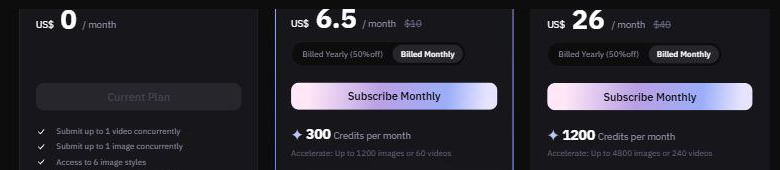
Wan's plan cards on create.wan.video with billing set to monthly, 3 October 2026. The struck-through $10 and $40 apply on neither billing term.
Worth knowing before you buy, the plan covers create.wan.video only. Using Wan through the API is a separate purchase, and the same model through Runway costs $1.00 for those five seconds.
Adobe Firefly
Adobe Firefly has the most predictable price on this page. Every regular plan works out at 50 cents a five-second video, because the credits and the video counts scale together. Standard is $9.99 for 2,000 credits and up to 20 videos.
Pro is $19.99 for 4,000 credits and 40 videos.
Pro Plus is $49.99 for 10,000 credits and 100 videos.
The gotcha is the two prices currently on the page. Pro Plus reads $34.97 and Premium reads $139.91, and both carry "First year only. Ends Oct 21" in small type underneath. Year two is $49.99 and $199.99. The discount is 30% and it applies once.
What makes Premium interesting despite that is the unlimited line. For the first year it includes unlimited generations on Veo 3.1 Fast, Kling 3.0 and every image model, which at 200 clips a month works out cheaper than metered credits anywhere else here.
Higgsfield
Higgsfield isn't really a generator, it's a shop. Its rate card prices Kling and Seedance and Wan and Veo and Hailuo and Sora and Grok in one currency. That makes it the easiest place on the web to see what one model costs next to another. Kling 3.0 is 7 credits for five seconds at 720p and 8 at 1080p. Seedance 2.0 is 22 and 45. Wan 3.0 is 8.75 and 17.5.
A credit costs 7 cents on Starter and 3.3 cents on Ultra, both on yearly billing. So the same 1080p Kling clip is 56 cents on the small plan and 26 cents on the big one.
The gotcha is in Higgsfield's own small print, and it answers a question people keep asking. The unlimited models and free generations are web only. They don't work through the MCP server, the command line, Canvas or the Supercomputer. If you were planning to drive Higgsfield from Claude, the unlimited part of what you bought doesn't come with you.
I've spent real money and real hours in Higgsfield. I pasted an Amazon URL for party balloons into Marketing Studio and got an 8-second landscape ad back in two or three minutes, with the product imagery pulled straight off the page. It refused a pair of boxing gloves and refused a recognisable branded product outright. The TV Spot preset crashed on me and the Wild Card preset worked on the retry. I wrote up what happened when I ran Marketing Studio on a product link at the time, and I keep every current plan and limit on my Higgsfield page.
Kling AI
Kling has the largest credit allowances on this page by a distance. Ultra is 26,000 credits a month, which is nine times Higgsfield's top yearly plan. What it won't tell you is what a generation costs, so none of that converts into a price per clip.
The gotcha is worth looking at twice, because it's on every card. Standard says "100 Credits = $1.06" and Pro says "$0.87". Those are worked out from the first-month prices of $6.99 and $25.99. The plans renew at $8.80 and $32.56, which makes the real figures $1.33 and $1.09. Every per-credit price on the monthly view is about 25% lower than what you'll pay from month two, and the same numbers are repeated in the comparison table further down.
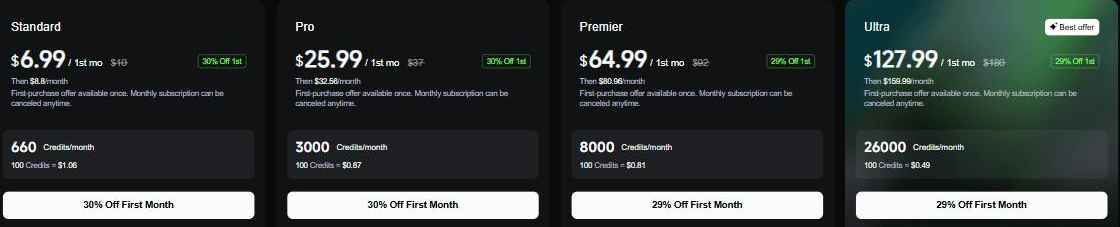
Kling's plan cards on kling.ai in the monthly view, 3 October 2026. The per-credit figure sits under the first-month price, not the renewal price above it.
Switch the toggle to yearly and this goes away. Pro is $293.04 a year. That works out at $24.42 a month for 3,000 credits, and the $0.81 per 100 credits Kling prints beside it is correct.
One more thing about that yearly tab. Kling 4.0 Flash is listed as early access on the Ultra annual plan and nowhere else, so the newest model is behind a $1,429.99 commitment. Every current plan and limit is on my Kling AI page.
Runway
Runway has the most honest rate card here and is the most expensive way to buy. Runway publishes what every model costs per second, in credits, and tells you credits cost a cent in the developer portal. Gen-4.5 is 12 credits a second.
Veo 3.1 is 20 credits a second without audio and 40 with it.
Wan 3.0 at 1080p is 20 credits a second and Seedance 2.5 at 1080p is 68.
That last one is the number to look at. 68 credits a second means $3.40 for a five-second 1080p Seedance clip, which is the most expensive single generation on this page by a factor of three.
The gotcha is that subscription credits and developer credits aren't the same price. Standard at $12 a month gives 625 credits, which is 1.9 cents each, nearly double the developer rate. Pro is 1.2 cents and Max is 0.8 cents. So the cheapest way to buy Runway credits depends on which door you use, and the subscription is worse value than the API until you reach the Pro plan.
Credits don't roll over on Standard or Pro. On Max one month's worth carries forward, and anything you buy on top never expires.
Google Veo, through Flow
Google prices Veo by the generation rather than by the second, which makes it easy to budget and hard to compare. Veo 3.1 Fast is 20 credits a generation, Quality is 100, and the Lite tier is 10. Everyone gets 50 Flow credits a day free, which is two Fast generations, and the daily pot doesn't roll over.
Google AI Plus at $4.99 adds 200 credits a month and Pro at $19.99 adds 1,000. Ultra adds 10,000 or 25,000 depending which Ultra you buy. None of those roll over either.
The gotcha is the price of quality. A Quality generation is 100 credits against 20 for Fast, so the better model is five times the price and your $19.99 plan buys 10 of them rather than 50.
Hailuo AI
Hailuo is priced per month, with no yearly option published anywhere I could find. Standard is $14.99 for 1,000 credits.
Pro is $54.99 for 4,500 credits.
Master is $119.99 for 10,000 and Max is $199.99 for 20,000.
In Hailuo's own generator a 5-second 2K clip on MiniMax H3 reads 60 credits, which puts a clip between 60 and 90 cents depending on your plan.
The gotcha here is expiry, and it runs the wrong way round. Subscription credits are valid for one month and then they're gone, with nothing carried forward. Credits you buy separately at $1 for 70 last until the end of the second calendar year after you bought them. So the credits you pay extra for outlive the ones you're already paying for, by about two years.
Dreamina
Dreamina publishes something nobody else does, which is how many videos each plan makes. Basic is 19 videos of 10 seconds, Standard is 48, Advanced is 220 and Ultra is 737. That's a genuinely useful thing to put on a pricing page and it's the reason Dreamina is easy to place here.
The gotcha is the same first-month trick Kling uses, printed more plainly. Basic reads $1.50 and then says "USD 1.50 for the first month, then USD 15.00/month" underneath. That's a 90% discount for one month on a plan that costs ten times more from month two.
There's also an oddity in its own arithmetic. Three plans state a rate of about 180 credits per dollar and the Basic plan states 1,050. One of those four numbers is wrong and Dreamina hasn't said which.
LTX
LTX runs two pricing systems that don't meet. The studio sells credits and never says what a video costs in credits. It runs from 8,000 a month for $12 on yearly billing up to 110,000 for $100. The API sells seconds, from 3 cents for 720p on the older fast model up to 39 cents for 4K on the newer pro one.
The gotcha is that the cheap tier can't top up. Buying extra credits starts at the Standard plan and on-demand top-ups are Pro only, so if you run out on Lite your month is over.
Grok Imagine
Same split as LTX and worse documented. SuperGrok is $30 a month and SuperGrok Plus is $100, and the only thing either says about video is that Plus makes 1080p. No allowance, no credit count, nothing.
The API does publish rates, and they're competitive. Grok Imagine video 1.5 is 8 cents a second at 480p and 25 cents at 1080p. The lite model is 2 cents and 14 cents at the same two resolutions. At 1080p that's $1.25 for five seconds through the API.
The gotcha is that none of that tells a SuperGrok subscriber anything. You cannot work out from xAI's own pages what your $30 buys.
PixVerse
PixVerse has a consumer app, and the pricing I can verify is for its API platform, where the entry plan is $100 a month for 22,250 credits. Its rate card is the most detailed here by some margin, down to the credit for each model and resolution and second. PixVerse's own worked example puts a dollar at five videos of five seconds at 720p.
It gets a row on the table that explains itself rather than a number, because a $100 floor isn't competing with a $5 subscription for the same buyer.
The gotcha is that API credits and web credits are separate purchases and the page says so plainly. Buying one doesn't get you the other.
Seedance
Seedance shows up on this page three times without having a row of its own, which tells you something about how these models reach people. Runway sells Seedance 2.5 at 1080p for 68 credits a second. Higgsfield sells Seedance 2.0 at 1080p for 45 credits per five seconds. Dreamina advertises Seedance 2.5 "from $0.04/sec" without saying at what resolution. Runway is the one charging $3.40 for five seconds.
What each plan actually gives you
Credit expiry is where most of the real money goes, and the four vendors here handle it four different ways.
Runway is the most generous of the four. Nothing rolls over on Standard or Pro, one month carries forward on Max, and purchased credits never expire at all.
Hailuo expires subscription credits after one month and keeps purchased credits for roughly two years.
Google expires everything you don't spend. The 50 free daily credits reset each day whether or not you used them, and monthly plan credits don't carry into the next cycle.
Higgsfield's Starter plan is a fixed 270 credits a month with no mechanism to add more, which is stated on the card as a feature.
The second thing worth checking is where your plan works. Higgsfield's unlimited models are web only. Wan's subscription covers create.wan.video and not the API. PixVerse's API credits don't work in the web app. In all three cases the restriction is printed on the pricing page and in all three cases it's easy to miss.
What people report
Two complaints have come up often enough across separate launches to be worth repeating.
The first is Higgsfield's queues. I've seen thirteen separate people raise this on X/Twtiter between 11 August and 3 September, all describing generations that take hours or never finish, and several of them on plans sold as unlimited. One put it as "the unlimited Higgsfield mode takes 4 hours per generation".
That matters here because this page recommends Higgsfield as a cheap way to buy other people's models, and queueing is the thing that would stop you. Higgsfield's own terms acknowledge it, saying unlimited usage "may be subject to dynamic speed adjustments during high-traffic periods". If you need a clip back in minutes, the cheap credit price isn't the whole picture. If you're generating overnight, it probably doesn't touch you.
The second is where Google Veo works. Four people on X/Twitter between 27 August and 22 September found features missing where they live, including one who said "Its not available in Ethiopia though". Google doesn't list which countries get which Flow features, so this is worth checking before you subscribe rather than after.
Across the launches and replies I've read since August, no complaint about the other tools here has come up often enough to report. That covers Runway, Kling, Wan, Hailuo, Dreamina, PixVerse and LTX.
Who this is for
If you make 20 or so clips a month and don't mind which model you get, use Wan at $5.
If you want a named model at a stated resolution and a price that doesn't move, use Adobe Firefly at 50 cents a clip on any plan.
If you want to try several models without taking out four subscriptions, use Higgsfield, where everything sits on one credit price.
If you generate more than 100 clips a month, take Adobe Firefly Premium while the first-year unlimited offer lasts and look again in twelve months.
If you're building a generator into something automated, use Runway, because it's the only tool here that publishes a per-second rate and a credit price together.
Where this comparison breaks down
Three tools on this page can't be priced per clip at all, because Kling, LTX and Grok don't publish what a generation costs. That's not an oversight on my part, it's a gap on their pricing pages, and it's the single most useful thing any of the three could fix.
Retries aren't counted anywhere here, and they should be. Nobody gets the shot they want first time. A tool that's 20% cheaper per clip and needs twice as many attempts is more expensive, and no vendor publishes anything that would let you work that out.
Resolution isn't consistent across these vendors. Wan and Firefly publish video counts without saying at what resolution, so their figures may be for something smaller than the 1080p everyone else is quoting.
I'm comparing price here and not output. Nothing here says which of these makes a better five seconds, and for most people that matters more than the money.
Other tools do this job and aren't on this page. These are the ones I track week to week.
Questions people ask
Does generation through Claude or MCP use the same plan allowance, or cost extra?
On Higgsfield the answer is neither. The unlimited models and free generations don't work through MCP or the command line or Canvas at all. So you're back to spending credits for anything you drive from outside the website. That's stated on Higgsfield's own pricing page.
What does a clip cost?
Between 8 cents and $3.40 for the same five seconds, depending entirely on where you buy it. The cheap end is Wan's own subscription and the expensive end is Seedance 2.5 bought through Runway's developer credits.
Method and freshness
Prices checked weekly on each vendor's own pricing page. Every figure here was read on 3 October 2026, with each plan's billing control set to monthly and to yearly and both states recorded.
Where a vendor doesn't publish something, I've written that rather than estimated it.