Higgsfield Pricing: Current Plans and What They Actually Include
Last updated: 6 October 2026
Author: Greg Preece — I cover AI video tools and practical creator workflows.
Prices checked weekly on Higgsfield's own pricing page.
Higgsfield's pricing page puts a 30% OFF badge on the annual billing toggle. Five paid plans sit under that badge, and one of them is 30% off. Starter costs $19 either way. Plus is 20% off and Ultra is 23%. Team is 18%, and only Scale on the business tab gets to 30%.
Higgsfield is a platform that sells other companies' video and image models alongside its own, and meters everything in credits. It publishes a rate for nearly every model it carries, which makes it one of the easier platforms to cost accurately. Getting from that rate to a price still means knowing what a credit costs on your plan, and that is what changes the answer.
On this page
Current [Higgsfield](/articles/best-ai-character-consistency-tool-for-indie-filmmakers) plans
There are two sets of plans, one for individuals and one for teams.
| Individual plan | Monthly | Annual, per month | Credits a month | Video jobs at once | Commercial use |
|---|---|---|---|---|---|
| Free | $0 | not offered | 0 | 1 | No |
| --- | --- | --- | --- | --- | --- |
| Starter | $19 | $19 | 270 | 2 | Yes |
| --- | --- | --- | --- | --- | --- |
| Plus | $59 | $47 | 1,200 | 6 | Yes |
| --- | --- | --- | --- | --- | --- |
| Ultra | $129 | $99 | 3,000 | 8 | Yes |
| --- | --- | --- | --- | --- | --- |
Ultra also sells at 6,000 and 9,000 credits a month, and you have to pick the size before any price shows. On monthly billing the 6,000 plan is $250 and the 9,000 plan is $375. Both are discounted for the first payment, to $220 and $310. On annual billing they work out at $194 and $270 a month.
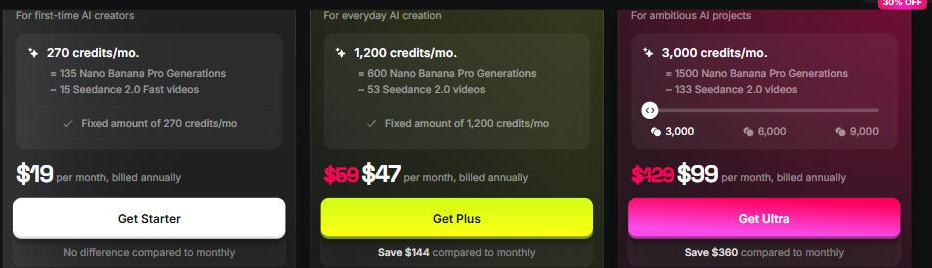
Higgsfield's plans on its pricing page.
The video jobs column comes from Higgsfield's comparison table. The Plus and Ultra plans on the same page say something different, and that is dealt with below.
| Team plan | Monthly list | Annual, per seat per month | Credits per seat | Video jobs at once |
|---|---|---|---|---|
| Team | $79 | $65 | 1,000 | 16 |
| --- | --- | --- | --- | --- |
| Scale | $215 | $150 | 2,500 | 32 |
| --- | --- | --- | --- | --- |
| Enterprise | custom | custom | custom | not published |
| --- | --- | --- | --- | --- |
Both team plans default to 5 seats and are sold on annual billing. Switch the page to monthly and both are cut for the first payment, Team to $69 and Scale to $169, against list prices of $79 and $215.
What Higgsfield charges per generation
A few of the models people actually use, all at 720p.
| Model | Credits |
|---|---|
| Seedance 1.5 | 3 per 5 seconds |
| --- | --- |
| Wan 3.0 | 8.75 per 5 seconds |
| --- | --- |
| Kling 3.0 | 7 per 5 seconds |
| --- | --- |
| Wan 2.6 | 7 per 5 seconds |
| --- | --- |
| Wan 3.0 Prime | 15 per 5 seconds |
| --- | --- |
| Seedance 2.0 Fast | 12 per 5 seconds |
| --- | --- |
| Seedance 2.0 | 22 per 5 seconds |
| --- | --- |
| Google Veo 3.1 Fast | 16 per 4 seconds |
| --- | --- |
| Google Veo 3.1 | 40 per 4 seconds |
| --- | --- |
| --- | --- |
| Nano Banana Pro image | 2 per image |
| --- | --- |
Turn that into money and the plan matters more than the model. A 5-second 720p Kling 3.0 clip costs 49 cents on Starter, 27 cents on Plus with annual billing and 23 cents on Ultra with annual billing. Those are the same clip on plans costing $19, $47 and $99 a month, so read the plan price next to the clip price rather than on its own.
What each Higgsfield tier delivers
The annual toggle is badged 30% off and one plan is. Starter is the same $19 either way, and the page says so directly underneath. Plus is 20% off and Ultra is 23%. Over on the business tab, Team is 18% and Scale is 30%. So the badge is accurate for exactly one of the 5 paid plans it sits above.
The team plans are not a volume discount. They cost roughly twice as much per clip as Ultra does. A 5-second Kling 3.0 clip is 46 cents on Team and 42 cents on Scale, against 23 cents on Ultra. What the extra buys is seats, shared credits and single sign-on. It also buys spend controls and indemnification. It does not buy cheaper generation, and Scale gets you fewer credits per dollar than Plus does.
Scale's own saving figure is wrong. The plan shows $215 a month falling to $150, and then says you save $228 a year by paying annually. $65 a month for 12 months is $780. The equivalent figures on Team, Plus and Ultra all add up correctly, so this one is a mistake rather than a different calculation.
Starter will not tell you which models it runs. It says access to selected models only, and does not list them. It does say Seedance 2.5 and Seedance 2.0 are both out and that Seedance 2.5 needs Plus. So the cheapest paid plan cannot run the model Higgsfield markets hardest, and you cannot find out what else it cannot run until you have paid.
Credits expire. They do not roll over and they clear at the end of each cycle. On an annual plan the cycle refreshes every 30 days from the day you subscribed, not on the 1st of the month, which is the sort of thing you only notice after losing a month's worth.
Higgsfield now says in writing that unlimited is the slow queue. Its own explanation of how unlimited works says generation speed and how many jobs run at once "may temporarily vary during periods of exceptionally high system load or peak traffic hours". It then offers the fix. Turn unlimited off and switch to credit mode, and you "bypass the standard queue and return to maximum speed instantly". That is the vendor confirming that paid credit generations jump the queue and unlimited ones wait in it. It reads very differently once you have read the section further down.
The unlimited windows do not work everywhere. They only work on the Higgsfield website. They do not apply through the command line tool, the plugin, Canvas or Supercomputer. That is in small print under the plans rather than on them.
The page still contradicts itself on how many jobs you can run at once. The Plus and Ultra plans say unlimited paid parallel generations, badged as new. The comparison table further down the same page still shows 6 and 8 videos at a time. Both cannot be right, and Higgsfield has not said which.
Every plan claims the lowest cost per credit, and the table says no plan has a credit discount. Every individual plan lists "lowest cost per credit" as a bullet point, including Starter, which is the most expensive of the four. The credit discount row in the comparison table reads "not included" for all of them.
Higgsfield gives 3 different answers on the team seat minimum. The Team plan says 2 to 9 members, the questions below say a minimum of 3 and up to 15, and a footnote in the comparison table says the price is calculated for a minimum of 2 seats. Ask before you commit.
The free Genjutsu generations change with the billing toggle. Switch Plus or Ultra to monthly and the card offers 2 free 720p generations. Switch to annual and it offers 3. Annual is what the page loads with, so the bigger number is the one most people see. Starter gets none either way.
Credit packs exist and the price is not published. If you run out, Higgsfield says you can upgrade or buy a pack and the pack is added instantly. It does not print what a pack costs anywhere on the pricing page.
The free tier has no commercial rights, which rules it out for anything you are paid for.
What has changed recently
The headline prices have held at $19, $59 and $129 since I started checking them in mid-August. Everything else has moved.
The pricing page changed shape last week and changed back. On 30 August the Free and Ultra plans were gone, the whole business tab was gone, and what was left was 3 buyable plans plus a $3 two-day pass. The image allowances on Starter and Plus had been cut, from 135 Nano Banana Pro generations to 100 and from 600 to 500. And for the first time Higgsfield published what buying extra credits costs, at $1 for 33 credits on Team down to $1 for 15 on Starter.
All of that has gone again. Today the allowances read 135 and 600 as before, the business tab is back, and the credit pack prices are unpublished again. The only thing left over is an entry in the questions at the bottom explaining a promotion that gives a year of unlimited generations, sitting under plans that all say 7 days.
That is worth knowing for one practical reason. A price or an allowance you saw on this page last week may not be the one you see today, and neither version was announced.
Wan 3.0 and Wan 3.0 Prime were added to the published rates. Both rates have been cut since. Wan 3.0 now costs 5, 8.75 and 17.5 credits per 5 seconds at 480p, 720p and 1080p, down from 6.25, 12.5 and 27.5. Prime now costs 7.5, 15 and 30, down from 8.5, 17.5 and 38.5. You can see what the same clip costs on every other platform. At 720p that takes a Wan 3.0 clip from 61 cents to 43 on Plus.
A model that was free now costs credits. Ox Alpha is the reasoning model in Supercomputer. It turned out to be GLM-5.3 Flash from Zhipu AI, and it now charges credits where it used to be free.
The signup promotion on Ultra is 30% off. It was 20% until late August, and the plan prices behind it have not moved.
What people report about Higgsfield
Read this before buying an annual plan on the strength of the unlimited offer.
In a thread on 22 August, 6 separate accounts said the unlimited generation mode was not delivering what was advertised. The reports were specific rather than vague. One person timed his own generations across several days and got a consistent 4 to 5 hours for a single 5-second 720p Seedance 2.5 clip. Another, on the top plan, said roughly 1 in 3 generations sat in the queue for over an hour. One gave up on a film project because every generation took more than 2 hours to appear.
Higgsfield's own explanation of unlimited now says the same thing in politer language, which is the part I did not expect. Speed varies under load, and paying with credits is what gets you out of the queue.
The complaints are about the unlimited windows, not the metered credit prices. Nobody in that thread said a paid credit generation was slow. That points at a clear way to use Higgsfield, which is to buy it for the credits and treat any unlimited window as a bonus rather than the reason you subscribed.
The other thing worth passing on is what people have worked out for themselves. On the Gemini Omni launch thread on 28 August, 4 separate accounts described the same habit. Generate at 360p, which is cheap. Look at the result and only pay to upscale the ones worth keeping. One of them called it turning prompt iteration into a cheap testing loop. Nobody at Higgsfield markets the tool that way. On a platform where a bad generation costs the same as a good one, that habit is the most useful thing in the thread.
One person under the same post asked the question this page exists to answer. He wanted to know what the clip in the demo had actually cost to make, and said the adverts never show the bill.
Hands-on with Higgsfield
My Soul ID identity drift test against Nano Banana is where I ran 6 tests on my own face. Soul ID trained on roughly 20 to 30 portrait photos and held my face through medieval armour with no degradation, which surprised me. It also mapped my face onto every single person in a train carriage, ignored an instruction to change my clothes and rendered me in the same red t-shirt every time, and put strange warps on my lips whenever the expression was strong.
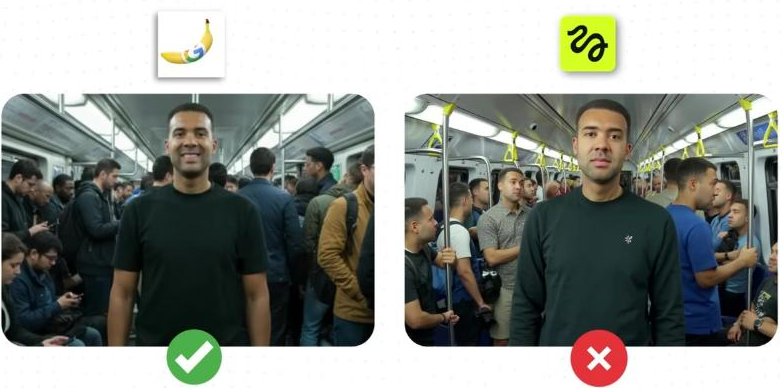
Higgsfield on the right, mapping the same face onto other people in the carriage. The tool on the left kept the bystanders distinct.
I have also used it for motion graphics work, and my write-up on SaaS motion graphics in under 5 minutes covers the whole process end to end.
If you want to try it, Higgsfield runs a free tier, though nothing you make on it can be used commercially.
Method
Figures come from Higgsfield's own pricing page. Every individual plan price, credit allowance and per-model rate was read live on 2 September 2026 and re-checked on 9 September 2026 with no change, and the team plans were read live rather than carried forward. Every cost per clip is worked out from Higgsfield's published credit rate and the credits its plans include, and is labelled as such rather than quoted from the vendor.