Speechify vs ElevenLabs Voice Cloning: I Tested Both Side-by-Side
Last updated: July 2026
Author: Greg Preece — I test AI voice and video tools hands-on to find the absolute best options for modern creators.
AI voice cloning technology has reached a point where you can replicate your voice online with just a few seconds of clean audio. If you are a content creator, narrator, or marketer looking to scale your content production, choosing the right platform is critical. If your AI voice clone sounds robotic or makes frequent pronunciation mistakes, it only wastes your editing time.
To help you decide which tool deserves your workflow, I put Speechify and ElevenLabs side-by-side in a head-to-head battle. I tested both platforms across six critical voice challenges: similarity, pronunciation, punctuation, realism, humor, and emotion.
Quick Comparison
If you want a quick summary of my testing, the table below breaks down how each AI voice cloning tool performed in my hands-on evaluations.
| Evaluation Test | ElevenLabs Performance | Speechify Performance | Winner |
|---|---|---|---|
| Vocal Similarity | Sounds very close, but added a slight Scottish accent | Clean output, but has a noticeably robotic tone | ElevenLabs |
| Pronunciation | Perfect execution of homographs ("lead" vs. "lead") | Perfect execution of homographs ("lead" vs. "lead") | Tie |
| Punctuation & Pauses | Excellent word emphasis and natural timing | Standard pauses; lacked deep contextual pacing | ElevenLabs |
| Realism & Fillers | Rushed the filler words slightly, but delivered clean audio | Handled question intonation perfectly, but had an audible background echo | Tie (Speechify for intonation, ElevenLabs for clean audio) |
| Humor Delivery | Natural, human-like cadence that made the joke land | Robotic delivery that ruined the punchline timing | ElevenLabs |
| Emotional Expression | Expressive, passionate, and dynamic vocal tones | Flat, automated, and lacking genuine excitement | ElevenLabs |
Prefer to watch? Here's the video. Prefer to skim? The full breakdown is below.
Quick Links
- Try ElevenLabs: Try ElevenLabs →
- Try Speechify: Try Speechify →
ElevenLabs Overview
ElevenLabs is an industry-leading generative voice platform designed specifically for creators, developers, and publishers who need ultra-realistic synthetic audio. It specializes in capturing natural human nuances, accents, and emotional fluctuations in text-to-speech generation.
If you are looking to replicate your voice for podcasts, video voiceovers, or localized content in multiple languages, ElevenLabs is built to handle highly conversational scripts without losing human expression.
Try it here: Try ElevenLabs →
How to Clone Your Voice in ElevenLabs
- Navigate to the Voices tab in your dashboard and select Instant Voice Cloning.
- Upload a high-quality, clean audio sample of your voice (typically between 10 seconds and a few minutes).
- Name your cloned voice, add labels (such as accent or language), and accept the copyright verification prompt.
- Click save to generate your model, then enter your script into the Speech Synthesis editor to begin generating audio.
Speechify Overview
Speechify originally built its massive reputation as a high-quality text-to-speech reading assistant for mobile and desktop browsers. It has since expanded its workspace into Speechify Studio, a comprehensive suite that offers AI voiceovers, AI avatars, and custom voice cloning.
Speechify is incredibly simple to navigate and is tailored for users who want to turn text documents, PDFs, or educational scripts into spoken-word files quickly.
Try it here: Try Speechify →
How to Clone Your Voice in Speechify
- Open the Speechify Studio editor and navigate to the AI Voice Cloning tool.
- Select Import your Voice and choose to upload a pre-recorded file or record directly inside your browser.
- Provide a brief reference sample (around 20 seconds of clear speech).
- Allow the platform to generate your profile, and begin typing your script in the browser editor.
The Six Head-to-Head Challenges
To test how well these realistic AI voice generators perform, I fed both tools identical text prompts designed to test specific limits of digital voice synthesis. Here is exactly how they compared.
Challenge 1: Vocal Similarity
The primary goal of any voice clone is sounding identical to the user. I recorded a clean sample of my own voice reading a specific sentence and used it to train both clones.
When I listened to the outputs side-by-side, Speechify's result had a distinct robotic quality. It missed some of the warm resonance of my natural voice. ElevenLabs, on the other hand, was much closer to my actual speaking voice. The only catch was that it generated a subtle Scottish accent that isn't present in my real-life speech. Despite the minor accent shift, ElevenLabs sounded significantly more like me than Speechify did.
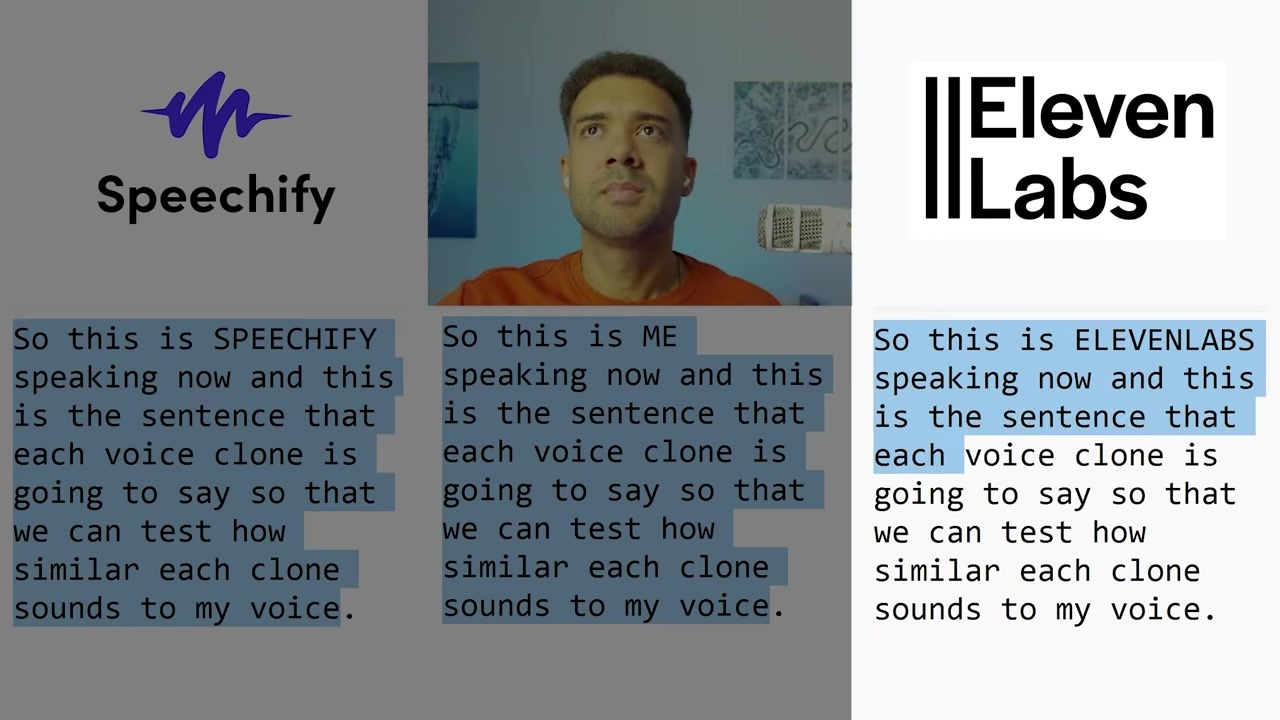
Caption: Comparing side-by-side vocal similarity outputs generated by Speechify and ElevenLabs.
Challenge 2: Pronunciation
English is full of homographs—words spelled identically that are pronounced differently depending on their context. To test their contextual intelligence, I had both clones read this sentence:
"The band will lead the parade, but they discovered the heavy box was made of lead. As the desert winds wind through the dunes, they needed to close the tent before it got too close to the storm."
This test featured three homograph pairs: "lead" (conduct) vs. "lead" (metal), "winds" (air currents) vs. "wind" (turn), and "close" (shut) vs. "close" (near). Both Speechify and ElevenLabs handled the context flawlessly, correctly pronouncing every single word on the first attempt.
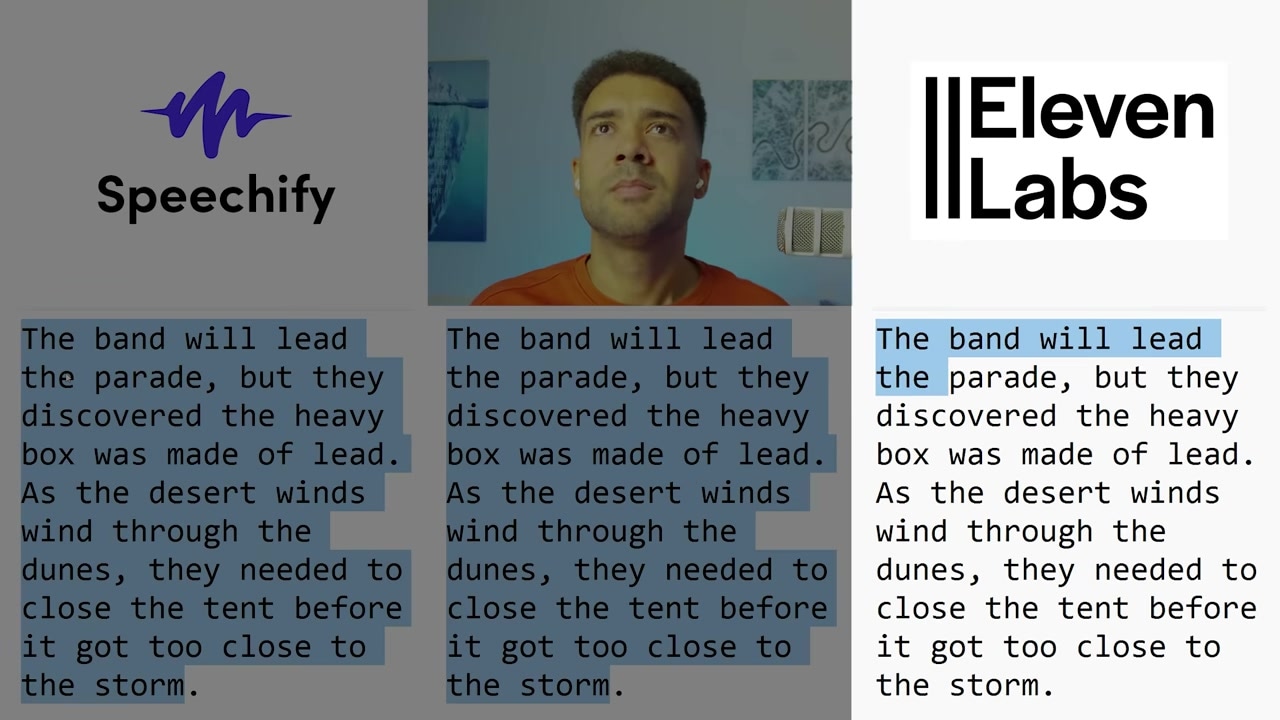
Caption: The dual-pronunciation script typed into both editors to see how they handle homographs like "lead" and "lead".
Challenge 3: Punctuation
Great narration requires natural pauses and shifting tones based on punctuation marks. I tested how both clones handled heavy punctuation, ellipses, and dramatic dashes with this line:
"Wait... what?! Are you seriously telling me that this—this—is how it ends?"
Speechify read the text cleanly but maintained a standard, somewhat flat pace across the punctuation marks. ElevenLabs easily took the win here. It intuitively understood the dramatic formatting, placed heavy emphasis on the repeated word "this," and paused exactly where a human speaker naturally would.
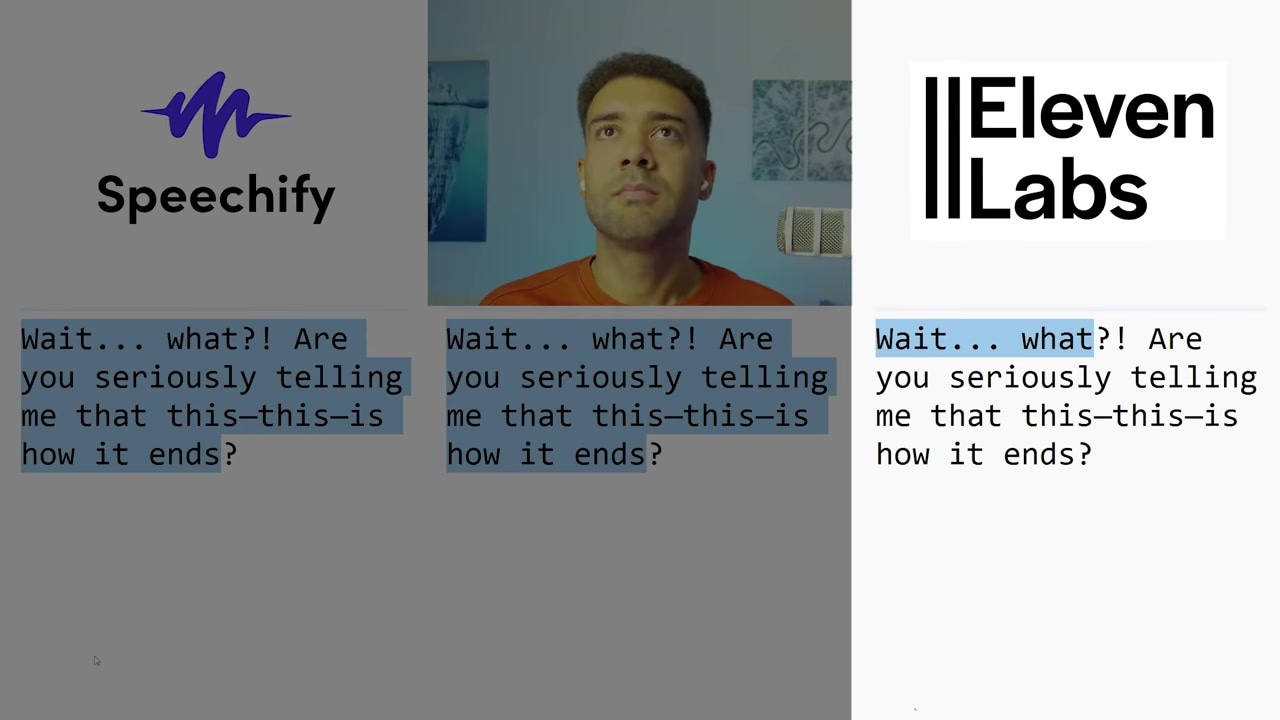
Caption: Generating speech for dramatic scripts to test how well each AI platform respects punctuation cues.
Challenge 4: Realism
To truly sound unscripted, an AI voice clone needs to handle conversational filler words like "uh" and "oh," alongside standard question structures. I tested them with this casual scenario:
"Oh, I didn't see you there. Uh, do you need help with something?"
Both tools had minor flaws in this round. Speechify dragged out the initial "Oh" for slightly too long, while ElevenLabs rushed through it too quickly. However, Speechify successfully captured the rising intonation required for the question in the second sentence.
The downside? I noticed a strange, metallic background echo in the audio output generated by Speechify. While Speechify took the win on question intonation, ElevenLabs' crystal-clear, echo-free audio made this test a tight draw.
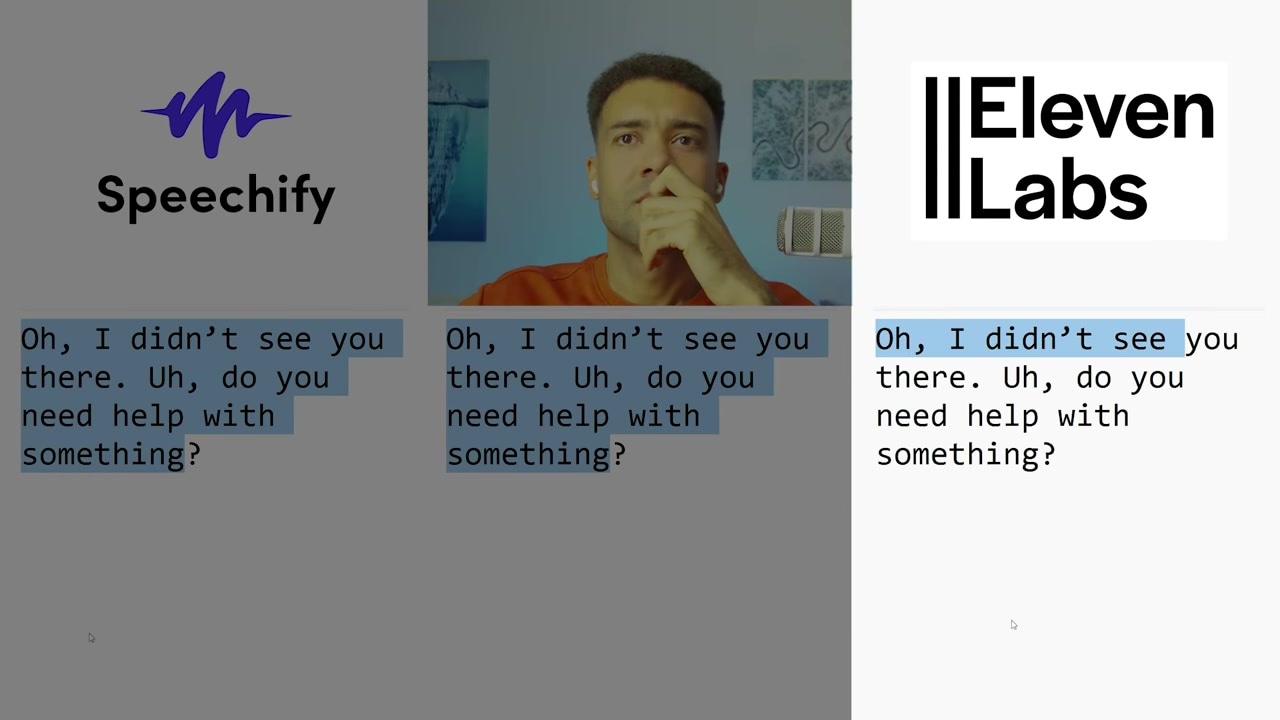
Caption: Putting conversational phrases with filler words like "uh" into the text-to-speech prompt.
Challenge 5: Humor
Delivering a joke successfully is entirely about timing and tone. If the voice sounds flat, the joke completely falls apart. I tested both models with a basic riddle:
"Why don't skeletons fight each other? They don't have the guts!"
Because of Speechify's robotic undertones, its delivery sounded unnatural and automated—similar to an assistant reading off an instruction manual. ElevenLabs read the script with natural, human-like comic timing, pausing perfectly before delivering the punchline.
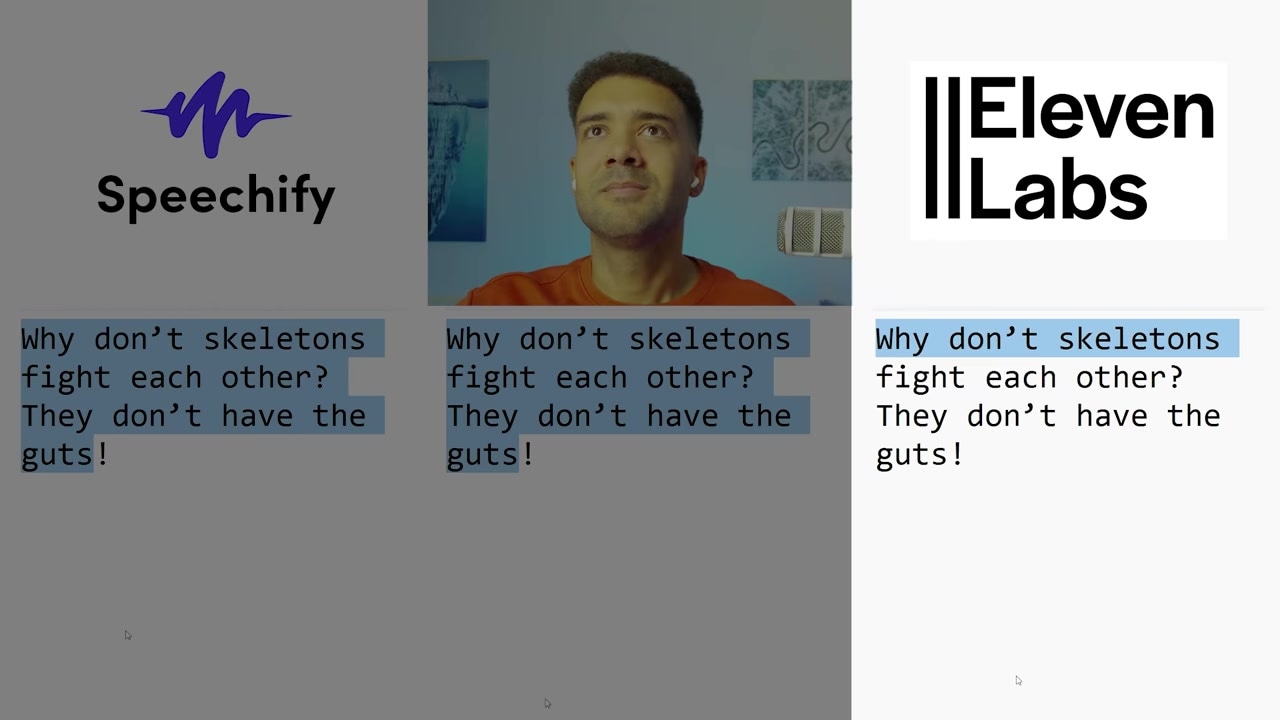
Caption: Comparing delivery timing and punchline pacing on a simple joke script.
Challenge 6: Emotion
For my final evaluation, I tested how well each clone could convey excitement and raw energy. I pushed them with this enthusiastic line:
"I can't believe it! After all this time, we finally did it!"
This is where the separation between the two platforms was most obvious. Speechify sounded completely flat, failing to raise its pitch or inject any genuine passion into the delivery. Conversely, ElevenLabs adjusted its energy level, generating a voice clone that sounded excited, triumphant, and fully human.
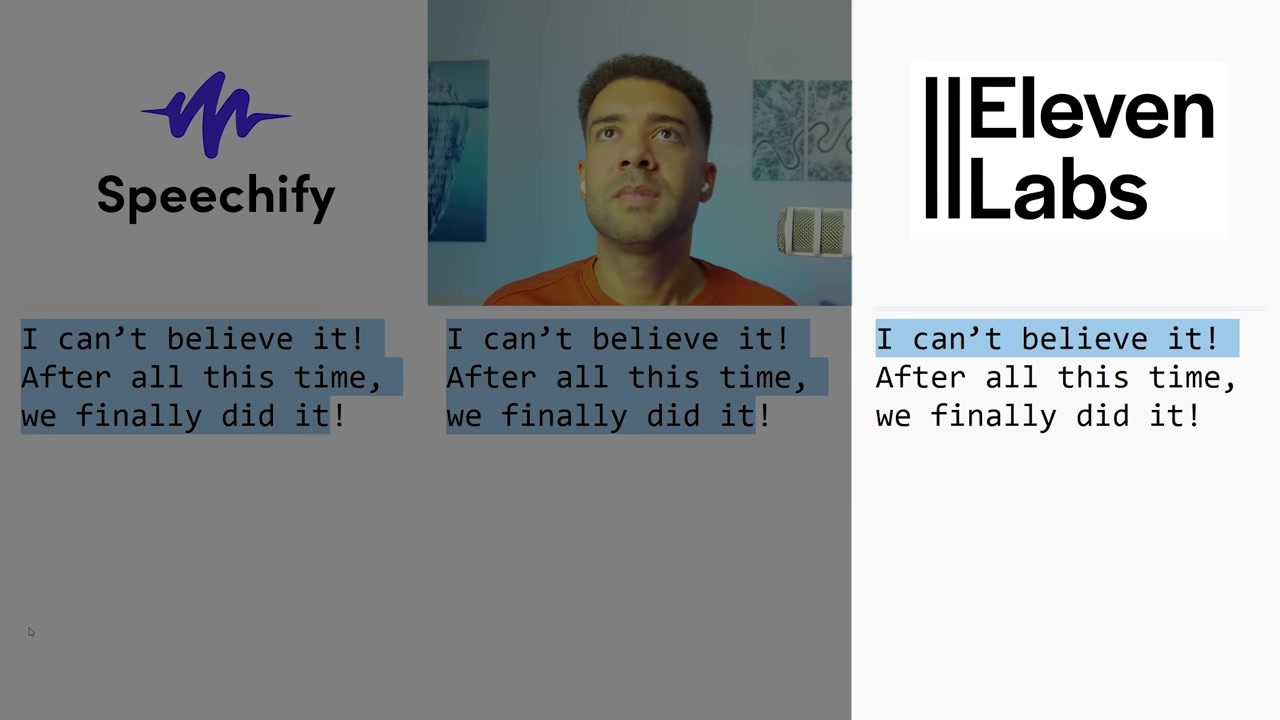
Caption: Testing high-excitement lines to evaluate if the AI clones sound dynamic or flat.
The Final Verdict
If you are trying to clone your voice online, the clear winner of this comparison is ElevenLabs.
Throughout all six performance tests, ElevenLabs consistently felt like a real human voice. It handled humor, complex emotional cues, and dramatic punctuation with ease. Its only minor mistake was adding a slight Scottish accent to my clone, but the overall vocal performance remained incredibly high-quality and convincing.
While Speechify is an excellent text-to-speech tool for reading PDFs and books, its custom voice cloning simply sounds too robotic for realistic content creation. Additionally, the audible echo in Speechify’s generated clips makes it difficult to use in professional audio production.
If you want a voice clone that sounds like a real person rather than a synthesizer, choose ElevenLabs.
- Get started with ElevenLabs: Try ElevenLabs →
- Get started with Speechify: Try Speechify →
Frequently Asked Questions
What is the difference between ElevenLabs and Speechify voice cloning?
Speechify is built primarily as an assistive reading tool that translates existing text documents into spoken audio, whereas ElevenLabs is designed as a generative AI audio engine. ElevenLabs focuses heavily on delivering natural, emotionally expressive vocal performances, while Speechify’s custom clones tend to retain a more standard, automated robotic quality.
Which AI voice clone tool is better for conversational content?
ElevenLabs is significantly better for conversational content, humor, and dramatic scripts. It automatically analyzes text contexts to insert natural pauses, vocal changes, and realistic word emphasis, which Speechify’s custom voice model struggles to replicate.
How do ElevenLabs and Speechify handle complex punctuation?
Both platforms respect basic punctuation like periods and commas. However, ElevenLabs performs much better with advanced punctuation marks, such as dashes, ellipses, and exclamation points, using them to adjust the pacing and emotional weight of its speech delivery.