Agent Opus Pricing: Current Plans and What They Actually Include
Last updated: 9 September 2026
Author: Greg Preece — I cover AI video tools and practical creator workflows.
Prices checked weekly on each vendor's own pricing page.
What Agent Opus is
Agent Opus makes a finished narrated video out of something you already have. That can be a script, an article, a podcast or a set of brand images. It writes the shot list, generates the visuals and narrates it, and hands you something you could post.
It is worth being clear about what it is not, because the name causes confusion. Agent Opus does not cut a long video into shorts. That is OpusClip, which is a different product from the same company, and Agent Opus's own help pages tell you to use OpusClip for clipping. The two share a credit balance, which is the only thing that connects them at the till.
On this page
- What Agent Opus is
- Current plans
- What a credit actually buys
- The number on the pricing page is the best case
- What each plan actually gives you
- When your credits disappear
- What this competes with
- Hands-on
- Method and freshness
Current plans
| Plan | Price | Billed | Credits |
|---|---|---|---|
| Free | $0 | Always free | 60 a month |
| Pro | $29 a month | $348 a year | 300 a month, quoted as 3,600 a year |
| Max | $129 a month | $1,548 a year | 1,500 a month, quoted as 18,000 a year |
Both paid prices multiply out to exactly 12 times the monthly figure, so there is no annual discount on either. There may be a separate and higher month-to-month price. The billing choice on the pricing page is drawn in the browser and would not load, so I could not read it, and I am not going to guess at a figure people would budget against.
Notice how the allowances are quoted. Free is given per month and both paid plans are given per year, side by side on the same page. Read straight down the page you are comparing 60 against 3,600, which is a 60 times gap. Read consistently it is 60 against 300, which is 5 times.

Agent Opus's three plans on 9 September 2026. The free allowance is quoted per month and both paid allowances per year.
What a credit actually buys
Credits are charged by how long the finished video is, in 10 second blocks, and the rate depends on which mode you use. The rate changing with the mode is the part that matters, and it is not on the pricing page.
Script to Video and Audio to Video both start at 10 credits per 10 seconds.
News and articles to video is 20.
AI UGC video is 30.
Motion graphics is 5 credits a second, which works out at 50 per 10 seconds.
So a 30 second video costs 30 credits as a script, 60 as a news piece, 90 as UGC and 150 as a motion graphic. The most expensive mode costs 5 times the cheapest one for the same length of video.
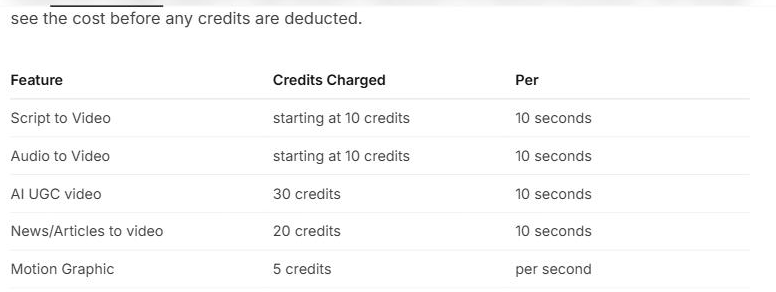
Agent Opus's credit rates, read on its help centre on 9 September 2026. The rate depends on which mode you use.
The number on the pricing page is the best case
Pro advertises 120 videos of 30 seconds a year. That is correct arithmetic at 10 credits per 10 seconds, which is the cheapest rate the tool has.
Run the same 3,600 credits through the other modes and the count changes.
120 videos as a script.
60 as a news or article piece.
40 as UGC.
24 as motion graphics
None of those is hidden. The rates are published, the pricing page shows the cost before you commit, and the maths is straightforward once you know the rate. But the headline number on the pricing page is the one people budget against, and it is the best case rather than a typical one. If you came for UGC ads, plan on a third of what the pricing page says.
What each plan actually gives you
The free plan watermarks everything you download, and the watermark reappears through the video rather than sitting in a corner. Pro and Max remove it.
There is a hard ceiling on length that applies whatever you pay. A transcript cannot exceed 1,700 words or 10 minutes of audio, and uploads are capped at 10 minutes too. Agent Opus does not publish an export resolution anywhere I could find, which is a real gap on a video product.
Pro gives you 1 brand brief, 1 custom avatar and 1 voice clone. Max gives you 5 of each, 25 custom style generations against Pro's 5, priority processing and 12% off credit top-ups.
If you want to try it before paying, the free plan is 2 short videos a month with a watermark.
When your credits disappear
On a monthly plan credits last 60 days, so they roll over once and then go. On an annual plan you get the whole year at once and the lot expires after 12 months.
The rule worth knowing before you spend is what happens to a generation you do not like. Credits are frozen when you start and returned if the job fails or you cancel it, but a video that completes successfully and simply is not good enough is not refunded. Refunds are for technical faults. Every attempt you would not publish is money.
That is the difference between this and a tool you pay for by the month. You are buying attempts, not results.
What this competes with
On price-per-finished-second Agent Opus sits alongside the other tools that generate video from a prompt rather than from footage you shot. There is a comparison of what a clip costs across those in my breakdown of AI video generation cost per clip.
Because the credit balance is shared with OpusClip, anything you spend generating here is not available for clipping. The plans for that side are on my OpusClip pricing page.
Hands-on
I have connected Agent Opus to my own Claude account through its connector and written up the steps, so videos can be triggered without opening the app. The walkthrough is in my Agent Opus connector setup guide.
Method and freshness
Prices are checked weekly on the vendor's own pricing page, and the credit rates come from its help centre. Everything here was last verified on 9 September 2026.